The articles you find listed throughout our website were written by Les Amis De La Giraudière, or in English, “the friends of La Giraudiere”, also contributions from volunteers and interns who have participated in the different programs at La Giraudiere. We hope you enjoy.
Tour De France
The Tour de France is the largest cycling race in the world. The duration of the tour de France is twenty-two days and has over 20 stages that is usually run over more than 3,000 km (1,864 miles). It is a circuit of France and neighbouring countries. In 2008 the tour took in Italy whereas in, 2007, the tour took in England.
The race is broken into stages from one town to another, each of which is an individual race. The time taken to complete each stage becomes a cumulative total to decide the outright winner at the end of the Tour. The Tour de France is one of the three major stage races and the longest of the Union Cycliste Internationale (UCI) calendar. While the other two European Grand Tours, Giro d’Italia (Tour of Italy) and Vuelta a España (Tour of Spain), are well known within Europe, they are relatively unknown outside.
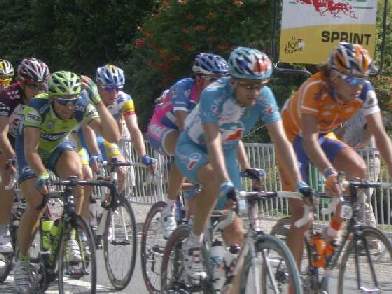
The Tour de France, in contrast, has long been a household sporting name around the world, even to those not generally interested in cycling. The race consists of between 20 to 22 teams with nine riders each. As with most cycling races, competitors enter as part of a team. Entry by means of invitation granted only to the best professional teams.
The tour organizers recently have utilized UCI points (based upon team riders/results) to determine which teams would gain automatic entry into the tour and then typically reserve 2-4 team slots to at large teams or French continental teams who would not be able to race in the tour based upon their individual team results. Each team, known by the name of its sponsor, wears a distinctive jersey.
Le Vélo
The dominant sports newspaper in France at the end of the 19th century was Le Vélo. Like other sports papers, it mixed sports reports with news and political comment. France was split socially over the guilt or innocence of a soldier, Alfred Dreyfus, who had been found guilty of selling secrets to the Germans. Le Vélo stood for Dreyfus’s innocence while some of its biggest advertisers, notably the owner of the Dion car works, believed him guilty. Angry scenes followed between the advertisers and the editor, Pierre Giffard, and the advertisers withdrew their support and started a rival paper.
It was to promote sales of the rival, L’Auto that the Tour de France began. It was a publicity measure to outdo the Paris-Brest et retour race organised by Giffard. The idea for a round-France stage race came from L’Auto’s chief cycling journalist, 26-year-old Géo Lefèvre. He and the editor, Henri Desgrange then discussed it after lunch at what is now the TGI Friday bar in Montmartre in Paris on November 20, 1902. L’Auto announced the race on January 19, 1903.
Le Tour
The plan was for a five-week tour from May 31 to July 5; however, this proved too daunting, with only 15 entrants, so Desgrange cut the length to19 days, changed the date to run from July 1 to 19, and offered a daily allowance which attracted 60 entrants, including amateur characters, some unemployed, some simply adventurous. It was these characters that helped catch the public imagination. The demanding nature of the race caught public imagination.
The race was such a success for the newspaper that the circulation, which was 25,000 before the 1903 Tour, increased to 65,000 after it; by 1908 the race boosted circulation past a quarter of a million, and during the 1923 Tour it was selling 500,000 copies a day. The record circulation claimed by Desgrange was 854,000, achieved during the 1933 Tour. Today, the Tour is organised by the Société du Tour de France, a subsidiary of Amaury Sport Organisation (ASO), which is part of the media group that owns L’Équipe.
How would you like to have your own page upon our website? You can how you say? simply by writing an article and sending it to us together with two photographs that relate to the article. La Giraudiere is a well-respected website among its visitors and also by the search engines that regularly visit.